Feature Flags: Power, Risk and Responsibility
feature-flag , product , process , risk , quality
It’s Friday afternoon.
You’ve just deployed a new feature.
Tests are green. The code review passed. Everything looked fine in staging.
Ten minutes later, the first reports start coming in.
It’s not a total crash.
It’s not even a blocking bug.
But something isn’t right. And it’s now in production.
At this point, you have two options: a full rollback or an urgent patch. Both have a cost.
If that functionality had been protected by a feature flag, you probably could have turned it off instantly.
Feature flags exist for exactly this reason: to reduce the blast radius of our decisions.
But every mechanism that introduces control also introduces complexity. And complexity, if not governed, becomes technical debt.
In this article, I’ll talk about feature flags assuming one thing: the management system is external to the codebase. Whether it’s a dedicated service, centralized configuration, or a feature management platform, the decision is not hardcoded. Because a flag that requires a redeploy to change is not really a feature flag - it’s just a constant.
Deploy and Release Are Not the Same Thing
Deploy is a technical event. Release is a product decision.
Feature flags exist to separate these two dimensions.
They allow you to ship code to production without immediately exposing it to users. They give you control over who sees what and when. They allow you to measure before you fully commit.
This separation is one of the pillars of modern engineering. But it isn’t free.
Segmentation: Users, Roles, Plans
The most common type of feature flag is based on user attributes: ID, role, subscription plan, specific groups.
This is the typical model in SaaS products.
It allows you to:
- Enable premium functionality
- Activate features for beta testers
- Differentiate behavior across roles
These flags are powerful because they align directly with product strategy.
The risk, however, is invisible fragmentation of the experience. When too many segments coexist, the application stops being “one” product and becomes a collection of variations.
Testing all combinations becomes difficult. Reasoning about global behavior becomes even harder.

They are ideal when segmentation is structural and stable (plans, entitlements, roles). They are dangerous when used as temporary shortcuts without a clear removal strategy.
Gradual Rollout: Percentages and Risk Control
Enabling a feature for 5% of users, then 20%, then 50%, is one of the most effective strategies to reduce risk.
The mechanism typically relies on stable hashing of user IDs, ensuring that the experience remains consistent over time.
This approach is particularly useful when:
- The feature is critical
- The impact is not fully predictable
- You want to observe real-world metrics before a full release
But gradual rollout requires maturity.
Without observability, clear metrics, and a rollback strategy, percentage rollout becomes just a distributed toggle.
It’s not magic. It’s a tool that only works within a system that measures, monitors, and reacts.
Client-Driven Flags: Lightweight but Limited
Client-controlled feature flags (cookies, local storage, technical opt-ins) have a different nature.
They are lightweight and immediate, often useful during exploratory phases or restricted betas.
They are not suitable for security-sensitive features. They can be manipulated. They are not a reliable source of truth.
And yet, they provide real value: they accelerate the feedback loop. They allow rapid validation of an idea before formalizing it into a structured rollout.
The problem arises when they remain in the system longer than necessary.
Remote Configuration and Governance
As a product grows, feature flags become an organizational concern.
Centralized configurations, audit logs, access control, management dashboards - at this stage, flags are no longer just code. They are process.
This approach enables:
- Real-time activation
- Immediate rollback
- Traceability
- Shared control across teams
But it introduces a subtle risk: the temptation to postpone decisions.
If everything can be toggled indefinitely, nothing is ever truly finalized.
Feature flags should be transition mechanisms, not permanent states.
The Hidden Cost: State Explosion
Every feature flag creates a new possible system state.
Two flags generate four combinations. Three flags generate eight.
Growth is exponential.
Not all combinations will be realistic, but the system does not know that. The code must still handle them.
Testing, debugging, and architectural reasoning become more complex.
Feature flags are power in the form of logical branching. And logical branching is complexity.
Best Practices to Avoid Technical Debt
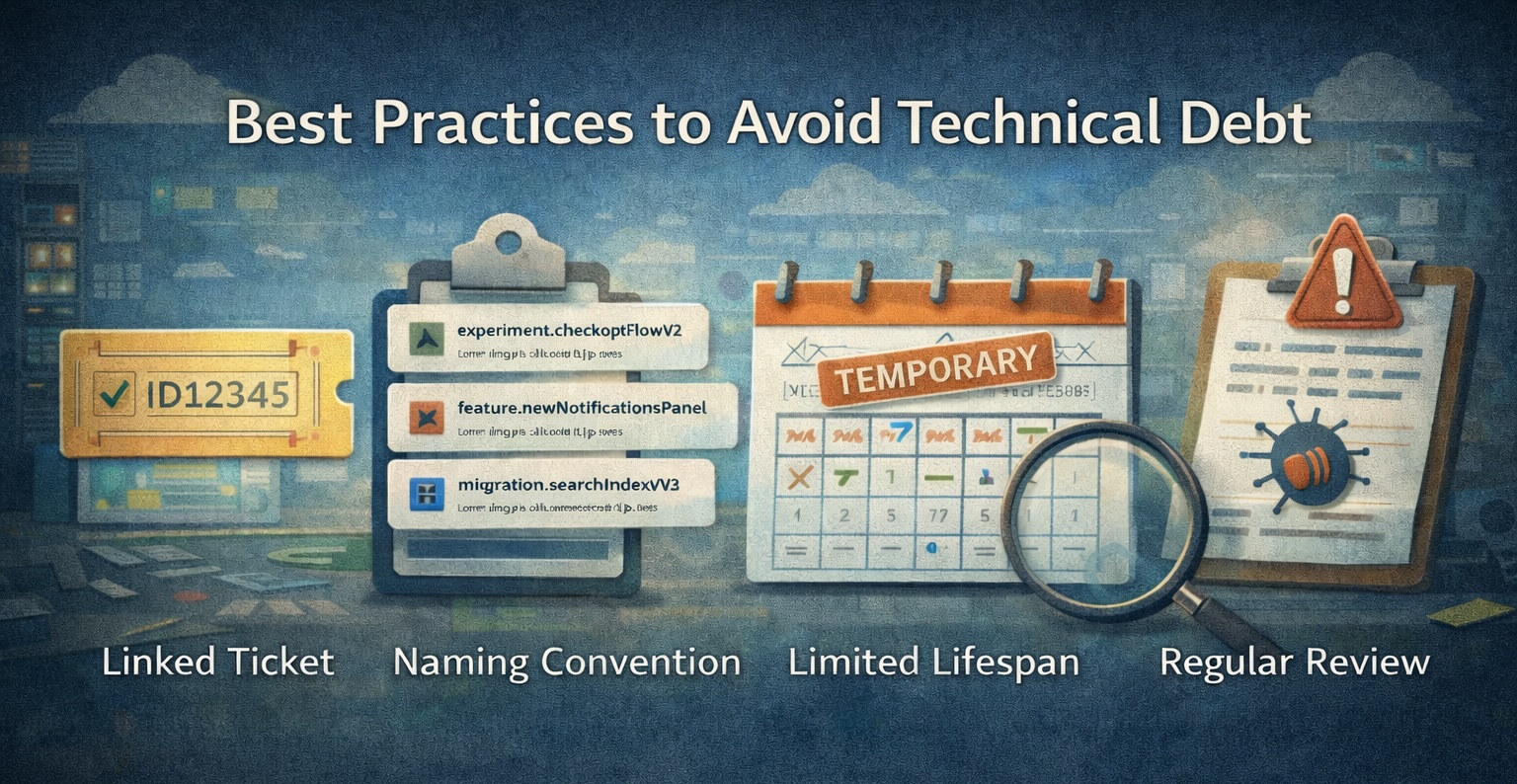
Feature flags must be treated as controlled technical debt.
They are not neutral. They are temporary compromises.
Every Flag Must Have a Ticket
A flag should be created with:
- A clear purpose
- An owner
- An explicit removal condition
Without a linked ticket, it is likely to outlive its usefulness.
Standardized Naming
Names should communicate context and intent.
Examples:
experiment.checkoutFlowV2feature.newNotificationsPanelmigration.searchIndexV3
A generic name makes it difficult to understand, months later, why the flag exists.
Limited Lifespan
Temporary feature flags should not live longer than a few months.
If a flag remains active too long, it means either:
- It has silently become architecture
- Or it has been forgotten
Both scenarios deserve attention.
Regular Reviews
Feature flags should be part of regular review processes.
A monthly review of active flags is often enough to prevent accumulation and maintain clarity.
This is structural maintenance, not an operational detail.
Treat Them Explicitly as Technical Debt
Feature flags should be visible in code quality metrics, refactoring checklists, and architectural discussions.
They are not implementation details. They are temporary design decisions.
The GitHub Model for User-Facing Features
For user-facing functionality, GitHub often adopts a different approach from silent rollouts.
New features are exposed as options that users can enable directly from the interface.
They are not just internal toggles. They are explicit choices.
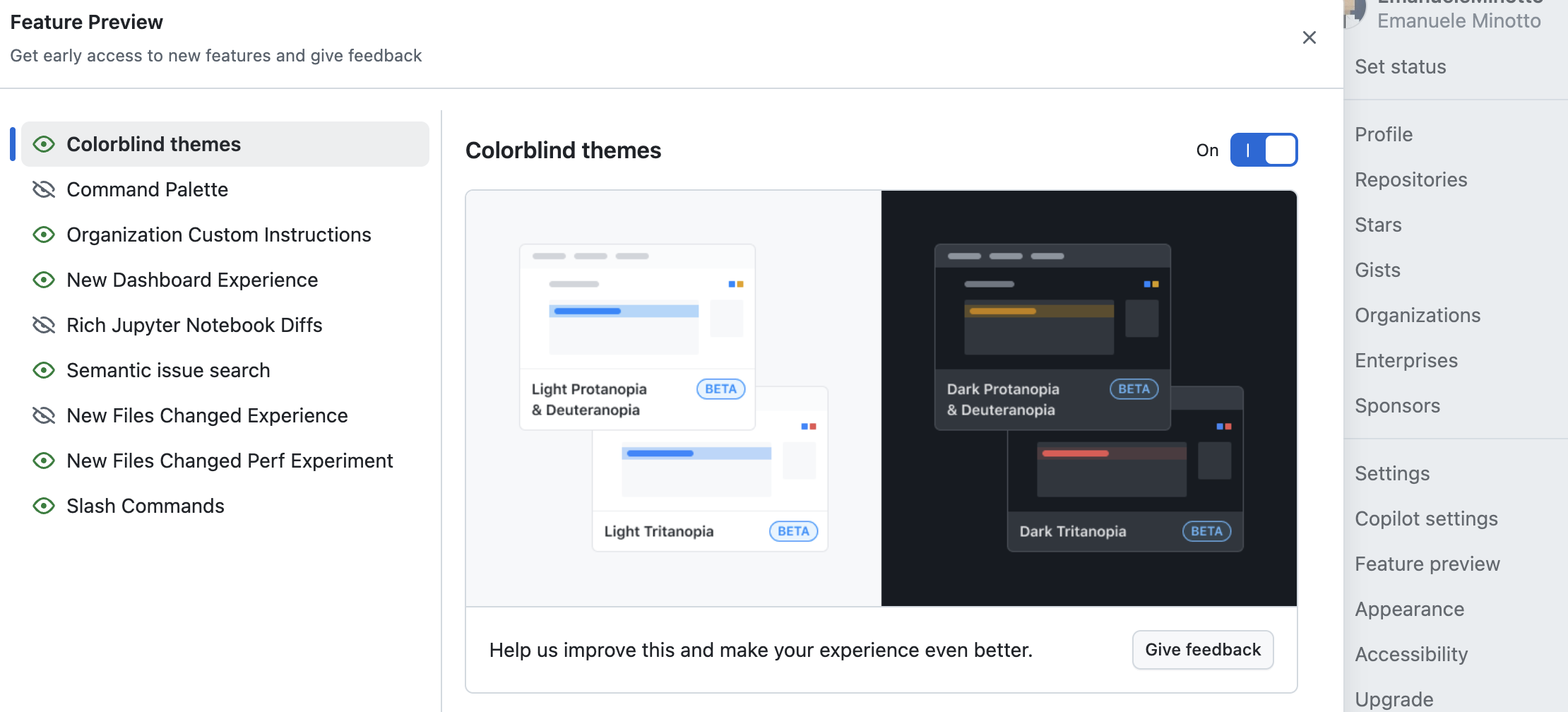
Users can:
- Activate the new experience
- Try it
- Revert to the previous one
This changes the release dynamic.
The rollout is no longer a gradual imposition. It becomes a consensual transition.
Not every feature can be handled this way. Security patches and bug fixes are not negotiable.
But for user-facing changes - especially those affecting workflows or interface - this approach is particularly effective.
It reduces friction.
It reduces backlash.
It increases the sense of control.
And it builds trust over time.
Conclusion
Feature flags are powerful tools.
They allow teams to reduce risk, experiment safely, control rollout, and separate deploy from release.
But every flag introduces complexity.
System maturity is not measured by how many feature flags exist, but by the discipline with which they are created, managed, and removed.
A feature flag should always be temporary by definition.
Knowing when to turn it on matters. Knowing when to remove it matters even more.