Shift Left vs Shift Right: Build Quality Like You Build Health
3 min read quality , process , testing , devops , agile , shift-left , shift-right
When we talk about Shift Left and Shift Right, we often describe them as testing strategies.
In reality, they represent something deeper:
how a team chooses to take care of its system over time.
The final quality of a software product is very similar to a person’s health. It does not depend on a single check. It is the result of daily prevention and continuous observation.
Shift Left: Daily Prevention
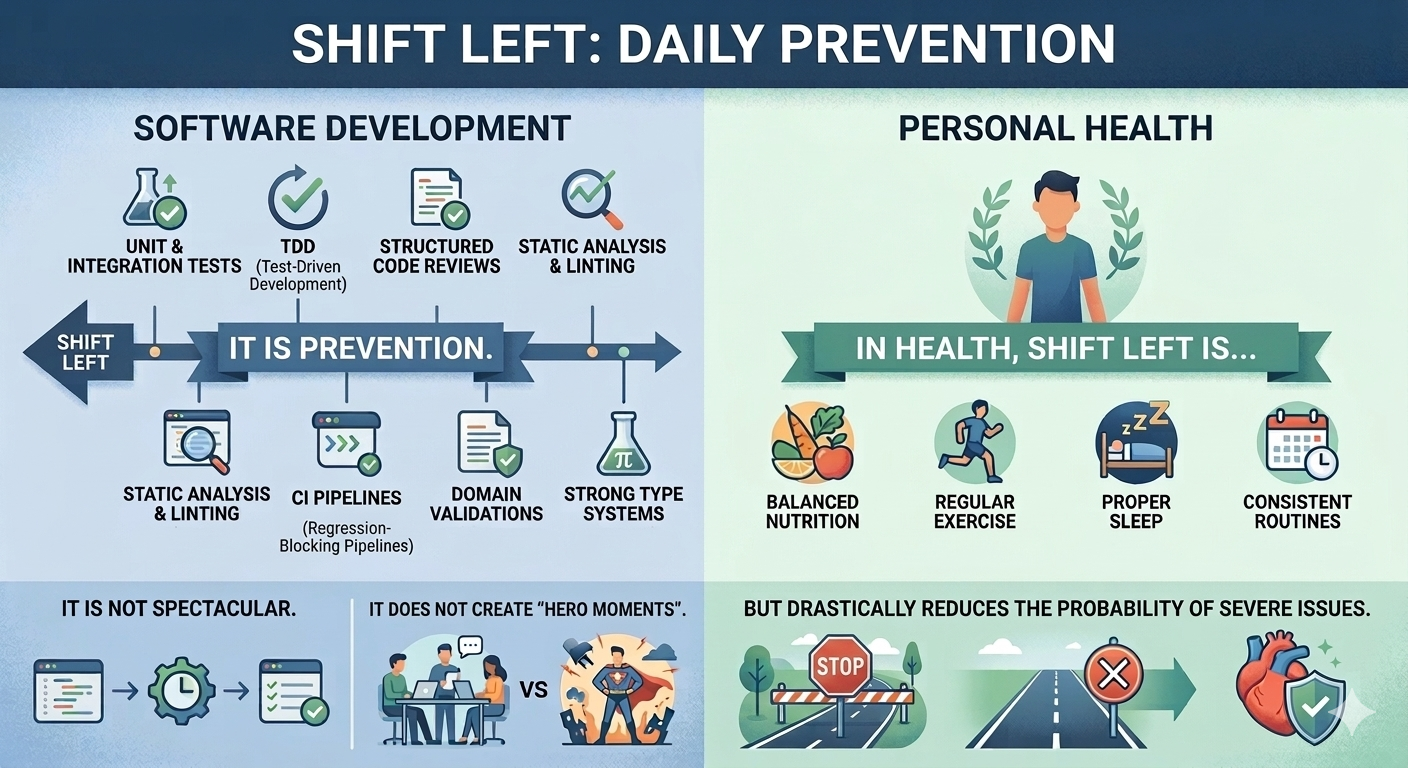
Shift Left means moving quality-related activities as early as possible in the development lifecycle.
In practical terms, it includes:
- Unit and integration tests
- Test-Driven Development
- Structured code reviews
- Static analysis and linting
- CI pipelines that block regressions
- Domain-level validations
- Strong type systems
It is prevention.
If we think in terms of health, Shift Left is:
- Balanced nutrition
- Regular exercise
- Proper sleep
- Consistent routines
It is not spectacular.
It does not create “hero moments”.
But it drastically reduces the probability of severe issues.
The Technical Equivalent of a Healthy Diet
A well-designed CI pipeline might:
- Run linting with a frozen baseline
- Execute unit tests with a coverage threshold
- Perform static security analysis
- Block merges in case of regressions
Here, quality is not optional.
It is built into the team’s metabolism.
Like good nutrition, it does not solve everything.
But it lowers systemic risk.
Shift Right: Reality Check
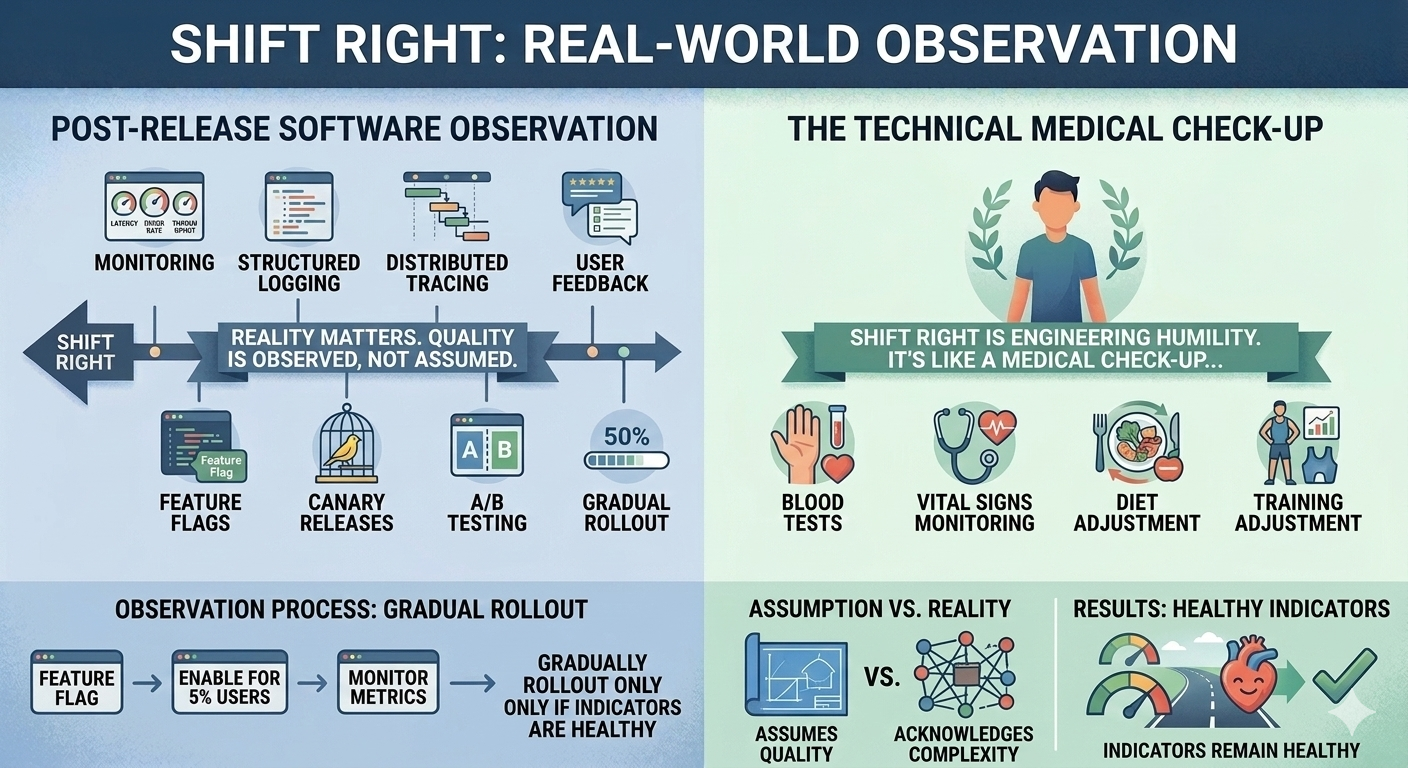
Even the most disciplined person goes for medical check-ups.
Because theory is not enough.
What matters is what happens in the real world.
Shift Right focuses on what happens after release:
- Monitoring (latency, error rate, throughput)
- Structured logging
- Distributed tracing
- Feature flags
- Canary releases
- A/B testing
- User feedback
Here, quality is not assumed.
It is observed.
The Technical Equivalent of a Medical Check-Up
A modern release strategy might look like this:
- Ship a new feature behind a feature flag
- Enable it for 5% of users
- Monitor error rate and performance metrics
- Gradually roll it out only if indicators remain healthy
This is the equivalent of:
- Blood tests
- Vital sign monitoring
- Adjusting diet and training based on real data
Shift Right is engineering humility.
It acknowledges that real systems are more complex than development environments.
Prevention Alone Is Not Enough. Monitoring Alone Is Not Enough.
Imagine two teams.
Team A invests only in Shift Left.
High test coverage, strict processes, but poor production observability.
Result: theoretical confidence.
Team B invests only in Shift Right.
Frequent deployments, strong monitoring, fast fixes in production.
Result: constant reactivity.
It is like:
- Training obsessively but never getting medical check-ups.
- Or ignoring prevention and only seeing a doctor when something breaks.
Real health comes from balance.
Quality as a Team Lifestyle
A software system is dynamic:
- It evolves over time
- It integrates with external dependencies
- It is used in unpredictable ways
For this reason, quality is not an event. It is repeated behavior.
And here lies an often underestimated factor: consistency.
You do not need twenty new tools. You need disciplined application of a few core mechanisms:
- Tests that always run
- CI that is never bypassed
- Monitoring that is actually reviewed
- Incident reviews that produce real action
Just like in health, it is not occasional intensity that makes the difference. It is continuity.
An extreme workout once a month does not replace daily movement. A massive yearly refactor does not replace good practices applied every day.
Shift Left and Shift Right are not opposites.
They are two components of the same healthy system:
- Prevent
- Observe
- Adapt
- Repeat
Final quality does not emerge only in production. And it does not emerge only during development.
It emerges from the combination of technical prevention and real-world feedback, applied consistently over time.
In other words: quality is a team lifestyle. 🏃